Wednesday, March 26, 2008

La Moskitia, Part One


Semana Santa began with an escape. I had set plans to leave Friday for La Moskitia, the remote eastern end of the country. However, my director decided our big Easter/ Father's Day/ Pool Day should be on the following Saturday. So I left with a mixture of excitement that comes with going somewhere new, and the anxiety of leaving some obligations behind. I wouldn't have stayed for anything, though. The opportunity to see the Moskito Coast was too rare and too tempting.

The bus came to my school an hour before classes ended, and I said to my assistant "Me voy!" as I ran out. I told Mr. Rodrigo, our P.E. teacher and forever-loyal Honduran, where I was going. As I stepped onto the bus, he said, "Mr. Brett, La Moskitia es Honduras." As in, there is no place one could go to find a better picture of what this country is, or what is once was.

The region gets its name, not from the bug, but from the natives' pronunciation of musket. However, the rumor is that there are sheets of mosquitos there, and it is an at-risk zone for Malaria. The Moskitos are a mix of natives and Spanish slaves. They have their own language, and have been largely unchanged unlike some other parts of the country.
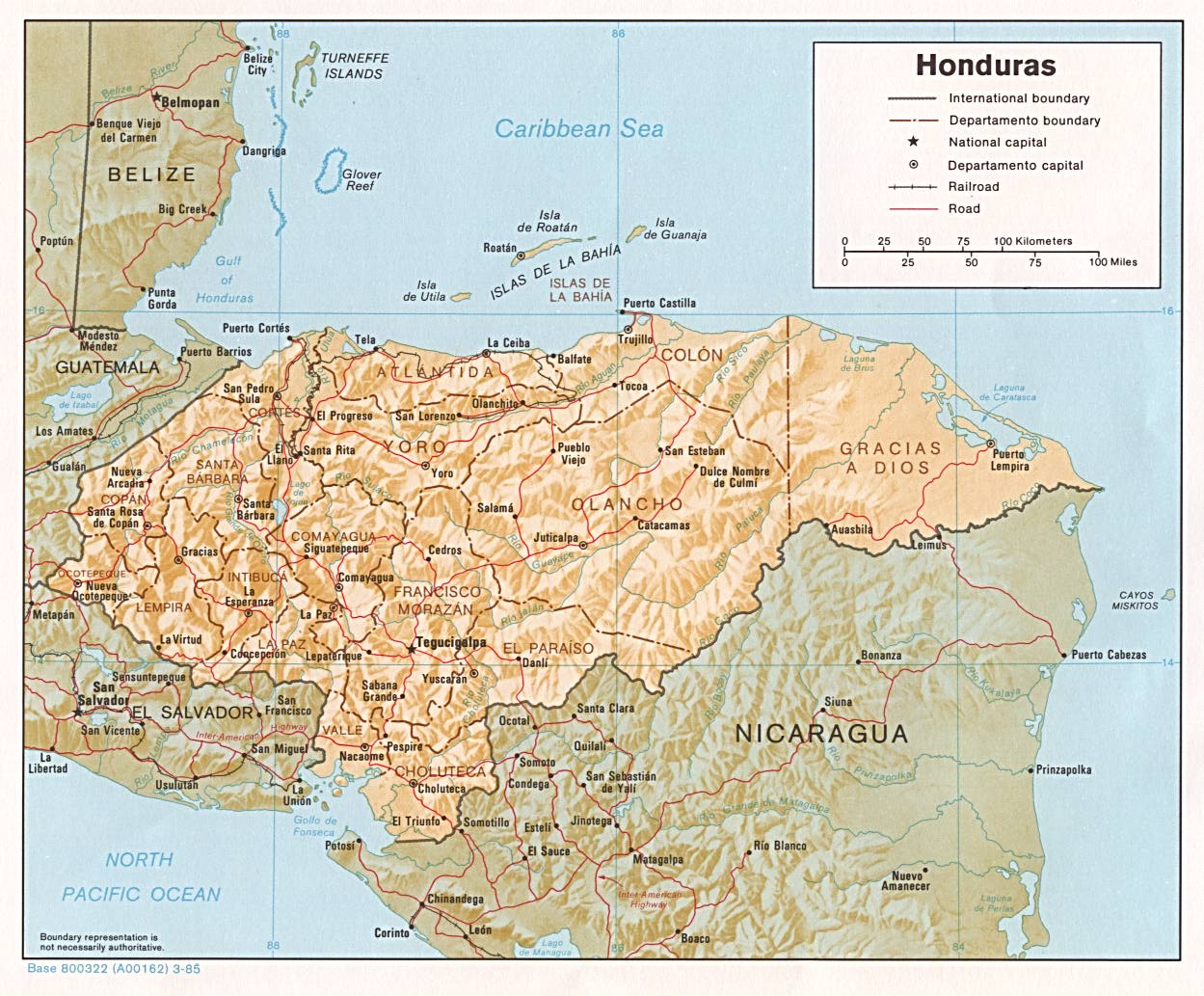
We drove north to a coastal town called La Ceiba on Friday. It's hard to see on the map, but it is in the dip of coastline. Thinking that, being with a group of Hondurans, we would certainly take a Honduran pace on this trip. But no lazy morning at the beach; we got a wake up call a little past three A.M. We drove the bus as far east as we could, to a small town called Tocoa. By 8 o'clock, we had loaded all of our gear into 4 x 4 trucks. There were smelly gas cans tied to the back bumper. We sat on 2 boards, eight of us squeezing together for the next leg of the journey. Our drivers were Garifunas, escaped African slaves that made their own villages along the Caribbean. They drove fast, and would deflect any comment about our progress. The unchanging answer: just a little further. A little further, it turns out, was another 5 hours of some of the most incredible countryside I've seen.
And so the trip began. I had no idea how far we were going, or what to expect as a destination. Every leg of the journey contained several endless segments, but I got lost in the absolutely beautiful scenery that was flying by us peripherally. All I knew: we were close to the Caribbean, and we would arrive in La Moskitia by boat that afternoon.
Check back soon. The story continues.
See some of the photos here:
http://www.facebook.com/album.php?aid=2129838&l=f7019&id=29705820

Sunday, March 9, 2008

Velocity


Here's the latest:

Every weekend, we've been tearing up the highways on bikes: Carlos, the Canadians Noel and Mark, and myself. The mornings lie low and quiet, the mountains are covered in clouds, and there is less traffic. Since the region is mountainous, we go up in order to go down. Last week, we rode out to Lago de Yojoa, which is a giant lake right on the major route between Tegucigalpa and San Pedro Sula. We stopped at the lake, ate fish (fried with head and tail attached), hung out in hammocks, and acted pretty lazy. To avoid the arduous ride home, we caught a chicken bus that would let us stuff our bikes on board. A chicked bus has no chickens, but stuffs lots of people inside, so I guess it is like a chicken coop in that sense. They are generally hair-raising rides through the mountains.

This morning Carlos and I finally made the full ride to Comayagua, which is the old colonial capital of the country. The cathedral and park are popular for tourists. On the downhill sections of the ride, we were passing big buses and semis, which was satisfying after some hard riding earlier. When we got into the center of town, we cruised around the street market for a bit, eating cantaloupe, tortillas, and cheese. The ride was about 40km, so not too terribly long, but we're working up. It's amazing how long a day feels after a ride. We got to Comayagua by 9:30, and I felt like it must already be after noon.

Living in Boone got me stuck on the idea of human-powered pursuits, and right now that is most accessible through bicycling. I want to see much more of this country, and this is how I am doing it. I'd like to throw out a tentative offer on that note: I think I'll be here through July, so if anyone would be interested in coming for a visit, I could provide a place to stay and a bike. There's alot to see in this country, and traveling is pretty cheap (the exchange rate is 20 Lempiras to 1 dollar). So email me if you'd be interested!

In other news, Semana Santa is approaching, and I get a whole week off, which I welcome.
Finally, I've written a little about how it feels being here, a poem I guess.


Honduran Spanish

Streetlights bored yellow,
waiting every night in blurry loops
strung like cobwebs around lightbulbs

Taxis well-worn and seam-stressed
maneuver with the creak of old wood floors,
dip like rocking chairs over crushed asphalt

Damp Spanish,
damp heavy h's hang
on words, pull them head-
long like a stack of papers
spilling from a countertop
in a unified flop and scatter

Cacahuates, alcitrones, fresco:
toted through shaky aisles,
suspended baggies of fruit
bulging and knotted

Spanish thick and wet and sticky
like bubble gum it pops all over lips,
chewed up, blown again
into a tremedous, soggy pouch of air.


Check out some pictures of the excursions here: http://www.facebook.com/album.php?aid=2125016&l=c4c0b&id=29705820

Sunday, January 27, 2008

Serenades


Friday was Women's Day in Honduras, and most schools make a big fuss about it. At my school, we have about 15 women on staff, and an unbalanced 5 men. There were flowers and cake and speeches. Earlier that morning, I got up at 4 a.m. to meet two other teachers, Rodrigo and Ronmel, in a borrowed taxi cab. It rained the night before, and leaving my house in a hurry, I slipped off of my porch and fell into a stack of roofing tiles down below, breaking a few. I was fine. Ronmel brought his guitar and lyrics to songs with him. Our mission was to sing serenades to all the women from school.

It was a silly affair, due to our lack of sleep and tiptoeing around houses. We ruined some perfectly good songs that morning, but I think that's part of the fun. Spanish love songs are ridiculous by means of exaggeration, and it's hard not to laugh when you're singing about roses at dawn. We would serenade outside of the gate, and then run to the cab, giggling and dodging puddles.

I really like all of the teachers at this school. They are impressive people, and it's exciting and different to share these times with them.

Sunday, January 13, 2008

Returning to Honduras


My plane flight back to Honduras didn´t go as planned. I made the mistake of flying late on the Sunday before classes started. The schedule said that I would be in San Pedro Sula at 12:40 AM. As it turned out, I walked out of the San Pedro airport terminal at 4 AM. Never trust Spirit Air to be punctual.

My hostel was a tremendous help, however. The owner, Luis, picked me up at the airport at 4 o´clock and didn´t complain a bit. He and his wife Blanca run the hostel. In the morning, they made me coffee and got me to the bus station. San Pedro Sula is the city where you don´t want to be lost or alone, and I am incredibly grateful for Luis´help. I imagine he slept a few hours that night on account of me, and they only charged me $16 for the airport pickup.
The busride back to Siguatepeque was arduous... it took about 4 hours, and I would drift in and out of sleep, waking each time to some new eccentricity. One time it was a man standing in the aisle making a long sales pitch about some miracle vitamins that cure high blood pressure and body odor at the same time (only 100 little Lempiras!).

I succeeded in missing the first day of school, and took a short nap that afternoon. But I have a class assistant now! No more 27 vs. 1. Really, two teachers are so much better than one.
This past Saturday I went on bike ride towards La Esperanza with my friend Carlos. It is a difficult ride, with steep and sustained uphills, but we rode back down to Siguatepeque in a quarter of the time. The downhills were of the sort that make tears stream out of your eyes. ¡A la muerte!

Later that night, I rode out to a party at a discoteque/ cafe to meet some friends. The guards wouldn´t let me chain my bike up inside the front yard, so I chained it to a metal post just down the street. Later that night, I went to get it, and there was nothing on the post. I frantically searched, as if it could be somehow hidden in the shadows, but it was gone. I came to Honduras expecting to be robbed, but all the same, it came as a shock.
The walk home was about 50 minutes. 15 minutes out from my house, a thin guy, maybe 25 years old, ran up to me. I thought this was strange, so I asked ¿QuĂ© tal?...What's up? He said, after some small talk,

"My two friends back there want to rob you."
"What? Are you serious?"

The strange thing was how he was telling me about this. Was he trying to warn me, or what? I tried to stay calm, but it was an uncomfortable situation. I told him that I was going to a friends house, and cut down the next street close to where Carlos lives. The thin guy said something like "No, walk with me," but he didn't follow me. One of his friends threw a rock, which bounced off the ground and hit me in the leg. They all ran off giggling. I think they were drunk and wanted to play around.
It was enough to shake me up emotionally. And if my bike wasn´t stolen, I wouldn´t have been harrassed. Oh, well, new lessons and new stories to tell.

Feel free to keep in touch!
Email: brett.bort@gmail.com

Letters:

Brett Donahue
Del Sol Montessori Bilingual School.
Calle 21 de Agosto, Aptdo. #194
Siguatepeque, Honduras, C.A.

I will try to upload a video from the bike ride soon.
It was great to see some of you in December!

Friday, December 7, 2007

Climbing Walls


It's been a while since I've written. The inspiration comes and goes.

The school starts slowly on Fridays. The buses arrive a little late, and kids trickle into first period with groggy eyes. I arrived at 6:50 this morning, which for a normal day is on the late side, but today only a handful of people stood outside. The main door was locked, which meant that none of the directors were there. Quite naturally, I set my bike against the outside wall, climbed up until I was standing on the top of the frame. It was an easy mantle move up over the wall, and then a drop into the empty courtyard. I opened the doors, and the day continued as always, with the struggles and small victories of teaching and learning.

I've seen this stunt before, at a soccer game. I was sitting on the the top bleacher, at the edge of a high cinderblock wall, and a head pops up from the other side. Looking down, I saw a lankey Honduran tiptoe-ing on his parked bicycle. He waited for a moment of distraction, and in one rush of movement he was sitting, relaxed, on the bleachers. He had clearly made a habit of watching soccer games for free.

Maybe I am becoming Honduran.

I can't figure these kids out. They are uncontrollable at times, and then all they want to do is hug their teachers. If they see my on my bike, I take on an image beyond school. I am not just their teacher, but the teacher with a bike. It's really encouraging to see my students pressing their noses to the car windows and waving urgently, yelling ''Mister!''. Maybe most flattering of all is a quiet kid, Edgar, who came to school with a haircut like mine. Hopefully, I am affecting them in some quiet part of their childhood.
The kids bring me fruit. They want to share with me. Today I got three licha, which are spiny, red casings with grape-like meat inside.

Children's books always end with some whimsical high-note. Like in the story with cats trying to cook, the messes are happy learning experiences. I think that part of the goodness of childhood is seeing the world as neat and orderly, authored with a happy ending in mind. We don't like to talk to kids about the terrible nature of the world, and for some good reasons.

My experience is at times bright and joyful, like a book for children, where all the appliances in the kitchen are labelled, and the explosions in the oven are invitations to laugh.
  • The Mister climbs the wall, now everyone can go to school.
  • The Mister rides his bike! Ride, Mister Brett, ride!

The opposite is, of course, true. My class has grown from a full 25 to 27. I remember guiding river trips on the Ocoee, and some days I would have a seventh person (from the usual six) in my raft. The weight, apparent in every turn, was exciting and above all stressful. The paddle would bow under the pull of the water: the strain of a small rudder directing the mass. Class is indeed stressful. In order to check on all the kids, I can spend 10 seconds with each one and then move on.

And yet, the fruit and waving kids are simple enough. The world can be good enough, if I stop thinking about the difficulties so much. Children's books are true in their own way, because they have faith in the simplest things: sun-lit kitchen windows and cups of tea.

See some pictures here:
http://appstate.facebook.com/album.php?aid=2115209&l=08892&id=29705820

Wednesday, November 7, 2007

Settling In, Part 2


Life, no matter how strange, becomes normal. The colors that at first were vivid cease to attract the eyes, and new routes between school and home don't grab the imagination. I've seen quite a bit, so how different could a new path be? Of course, we work ourselves out of normalcy and find new adventures. We try to keep life exciting and new. If life never settles out, though, how can it ever be exciting?


Siguatepeque feels so normal now. It isn't too odd to be the extranjero, to use new words for fruits at the market, to be a teacher.


Getting comfortable here is not necessarily blending in, but accepting how slow my adaptation will actually be. I knew that my Spanish wasn't especially great coming here, but now I understand that I didn't know the language at all- I could only translate English words into their nearest equivalent. Spanish and English are not the same language with different vocabularies. Phrases that feel so natural and obvious to people here make little sense back in the States, and (of course) the other way around.

My point: I'm beginning to learn Spanish as a language in its own right. It is a slow change from stiff and grammatical phrasing to something sorta colloquial.

I used to think that I could go anywhere in the world and call it my home. I could resolve any cultural differences and survive happily. I'm not so flexible. I have been shaped quite obviously by the world I lived in for 20+ years. Hondurans, and their country, present some interesting and frustrating differences. They have a sturdy simplicity about them. They grow up fast, much faster than I did. I've heard that where there is more technology, children mature at a slower rate, and that seems very accurate right now. Sometimes when I teach, I imagine I'm teaching middle-aged men and women in clumsy little bodies.

They know things, just as simple as that. I don't know if I know anything, and here I see people that know everything that they need to know or possibly will ever know by their high school graduation. It's not ignorance or stupidity; they know who they are, and will grow old on the same sturdy feet planted on the same sturdy soil. In the States, there is a cloud of anxiety that hangs over our heads... insecure side-stepping, constant grabbing for a new image or a new cool. But here people search through different means. They are inundated with the knowledge and identity of their country. It's amazing, school's go all out for the independence parades. Kids have to memorize anthems and dates and symbols and a national heroes.
They precede their knowledge, written or simply understood, with bullet points.


  • Cana de Azucar


  • Arroz y Frijol


  • ...


  • and that's all: sugarcane rice beans


  • as if there is no need for further explanation.


  • Honduras is


  • what it is, unexplained and unexplainable.
An example: one of the teachers, Mr. Rodrigo, loves Honduran coffee. He pontificates on the health benefits, the rich flavor. But the coffee is stale and burnt to ash here. Mr. Rodrigo will always think the coffee, among many other things from Honduras, is "siempre rico," because it stirs more than the tastebuds. It stirs his patriotism.


  • It's not bad, it's just different.


Check out a few more pictures at: http://www.facebook.com/album.php?aid=2110028&l=eb769&id=29705820

Friday, November 2, 2007

Settling In

Del Sol Montessori just wrapped up its tenth week today. Life has settled in many ways, and the oddities of not-quite-third-world living feel normal. My job puts routine in my life like I've never known. Sometimes I go for night strolls (my neighborhood is really safe) and I'm surprised by how different the streets look. Streetlights with spiderwebbed powerlines dot the cobbled streets. I like sitting in the park and watching the town close down. The town drunk tucks his bottle in the waist of his dirty pants just in time to take his dreamy sidewalk dive.
I've been taking Spanish lessons at another school with a few other North Americans. If for nothing else, it gets me away from overlong days at school. I was helping my students make up sentences one day, and while writing "The boy rides his bicycle," I realized that I wanted to ride a bicycle. Two days ago, I found a cool old Magna 10 speed road bike, the kind with the foil logo on the head tube, and I just had to buy it. I feel like I'm flying to school in the mornings, weaving throught traffic with my right pant leg rolled up.
Riding is one of those little flings of freedom that keep life a little interesting. I miss all the flexiblility of college and climbing whenever I wanted, but structure is good too. Growing up is good.